
Agentforce Isn’t Vaporware. It’s Just Not Magic Either. Posted by Landon Harris
Landon HarrisThe Agentforce vaporware story is having a moment, and some of it is earned. A late-May Bloomberg investigation found that several of Salesforce’s flagship Agentforce demos, including ones featuring the University of Chicago Medicine, Williams-Sonoma, and Finnair, showed capabilities that were largely simulated and not yet live. In the UChicago Medicine video, patients refill prescriptions and get parking tips on cue. In reality, callers still hit a keypad menu and the chatbot was still in testing, not visible to most web visitors. Marc Benioff defended the spots as forward-looking marketing. The market was less forgiving, and the stock has had a rough year.
But the companies winning with Agentforce right now have figured out something the coverage misses: the agent shouldn’t do the work. It should understand the request, pull the right context, and hand off to a Flow that does the actual transaction. Get that division of labor right and the tool is reliable. Expect the agent to improvise its way to an outcome and you become the cautionary tale.
It isn’t only journalists raising eyebrows. Sentiment inside the Salesforce community is genuinely split. A mid-2025 Salesforce Ben poll found that half of respondents felt Agentforce still hadn’t moved past its hype cycle, and only about one in ten said their team actually used it.
Some of the skepticism is earned. The promise sold in the polished videos, an AI that quietly runs a whole patient-services operation or an entire support org with no scaffolding underneath it, is not what ships today. Point an agent at messy, ungoverned data and ask it to reason its way through ambiguity, and it will let you down. Expect a six-week, company-wide transformation and you will become the cautionary tale someone else writes about. The “turn it on and walk away” narrative is the part that deserves the eye-rolls.
But writing the whole thing off as vaporware is the wrong read, and it is not what we see in the field. CloudMasonry started putting Agentforce into real client projects within two months of its October 2024 launch, and a clear pattern has emerged: the tool is genuinely good when you give it a narrow job and pair it with a Flow, Salesforce’s point-and-click automation, to do the actual work.
That distinction matters more than most of the coverage admits. When an agent’s job is to understand a request, pull the right context, and then call a deterministic Flow to update the case, check eligibility, or route a customer to the right rep, you get the language fluency of a model paired with the predictability of logic you already trust. The agent handles the conversation. The Flow handles the transaction. That is a very different and far more reliable thing than asking a model to improvise its way to an outcome on its own.
For a software company client of ours, we built a support chat widget that now answers common questions, opens cases, and hands higher-tier customers to a live representative based on their support level. This internal bot went from kickoff to production in twelve weeks, not the six to twelve months people assume these projects take.
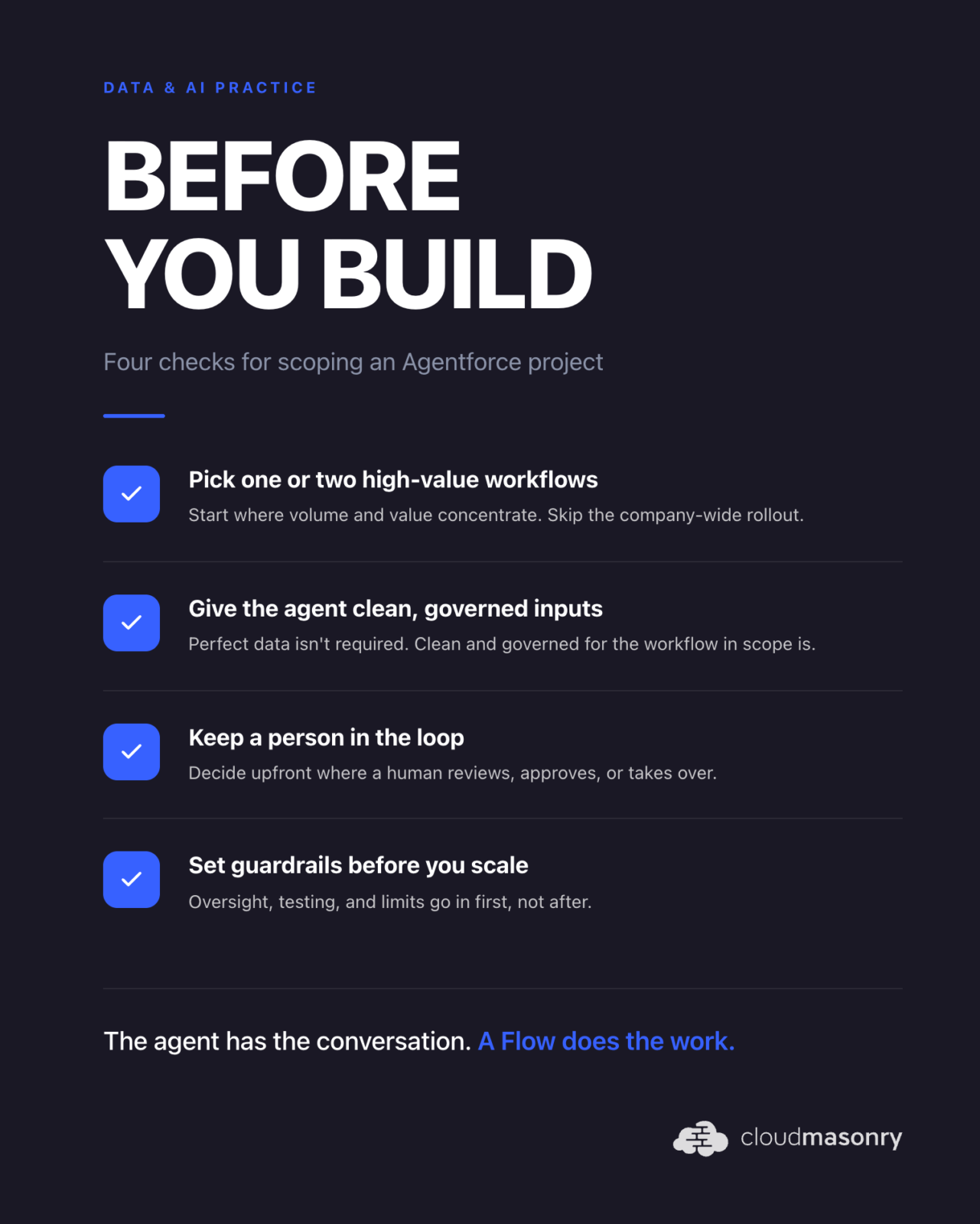
So what separates the wins from the disappointments? It usually isn’t technology. It’s the use case and prep. Most orgs are sitting on data that isn’t clean or governed enough for an agent to reason over reliably. Keep in mind that perfect data isn’t the goal (or requirement) to get started, don’t let perfection be the enemy of good. It is a reason to scope tightly: pick one or two high-value workflows, give the agent clean and governed inputs, keep a person in the loop when necessary, and put your oversight and guardrails in place before you scale, not after.
So, is Agentforce hype? In the places where it’s sold as magic, absolutely. Is it vaporware? Not on any project I’ve worked on. It’s a capable tool that rewards discipline and punishes shortcuts, which honestly makes it a lot like every other meaningful platform shift this ecosystem has lived through. The companies winning with it right now aren’t the ones who believed the demo. They’re the ones who picked a real problem, wired the agent to a Flow, and shipped something this quarter.
If you’re weighing where Agentforce fits, or want a second read on a use case before you commit, we’d love to compare notes. CloudMasonry is a full-service Salesforce consulting firm helping organizations design, optimize, and scale their cloud solutions across Sales Cloud, Service Cloud, Marketing Cloud, Revenue Cloud, and Data & AI.
Sources
- Brody Ford, “Salesforce Touts AI Promise Over Reality in SaaSpocalypse Fight,” Bloomberg, May 22, 2026. Link
- “Salesforce Has an AI Vaporware Problem,” Gizmodo, May 2026. Link
- “Salesforce is selling the AI future harder than it is delivering it,” The Next Web, May 2026. Link
- “Has Agentforce Moved from Hype to Reality?,” Salesforce Ben, July 2025. Link
- “A practical guide to Agentforce customer service in 2025,” eesel.ai, May 2026 (citing Salesforce’s October 2025 Agentforce 360 figures). Link
- “Agentforce Use Cases Analyzed: Sales, Support & RevOps Applications,” Oliv.ai, December 2025 (deflection ranges, data-quality and total-cost considerations). Link
- CloudMasonry, Demystifying Agentforce: From Hype to Real Outcomes (Dreamforce 2025 deck), internal.